The Science
Why these five.
Why not the other fifteen.
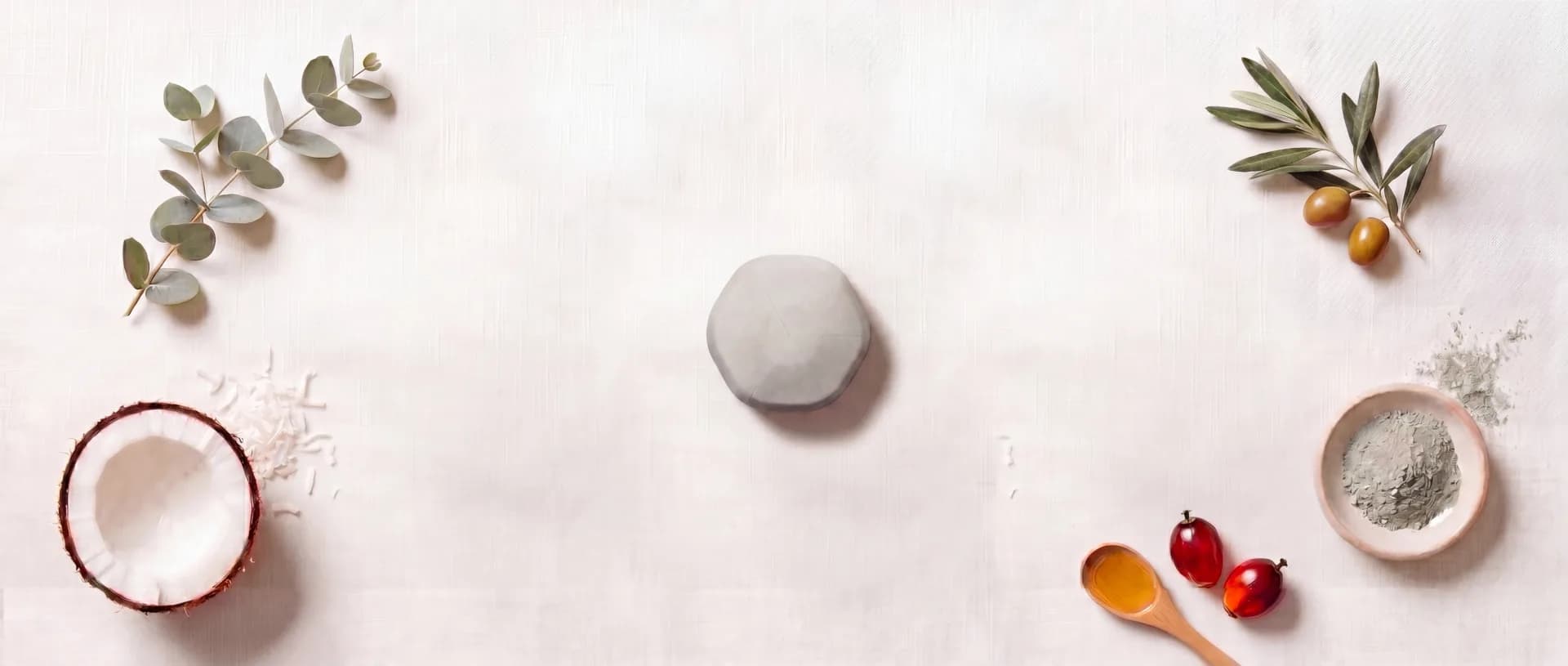
Most soap products use 15–20 ingredients. Many exist for shelf stability, fragrance complexity, or cost savings — not for your skin. Here’s why Split uses five and the science behind it.
The Base
Three organic plant oils. Three jobs.
The first three ingredients form the soap itself. Each oil saponifies differently, and the ratio is tuned so the bar cleans thoroughly without drying you out. All three are certified organic plant oils.
Saponified Palm Oil
The Foundation
Creates a hard, long-lasting bar with a stable lather. Palm oil produces the firmest base of any common soap oil — it's why the stack holds its shape through weeks of daily use without turning to mush in your shower.
Saponified Coconut Oil
The Cleanser
The primary cleaning agent. Coconut oil produces the most robust, bubbly lather of any soap oil and excels at cutting through oils and residue. It's an aggressive cleanser on its own, which is why it needs to be balanced.
Saponified Olive Oil
The Balance
Counteracts coconut oil's drying effect. Olive oil saponifies into a mild, conditioning soap that leaves a moisturizing finish on the skin. Without it, the bar would clean well but leave your skin feeling stripped and tight.
Sourcing
Why organic matters in soap.
Conventionally grown oils often carry pesticide residues, solvent traces from chemical extraction, and byproducts of industrial processing. In a product you rub on your entire body every day, those trace contaminants add up. Organic certification guarantees the oils are mechanically pressed from crops grown without synthetic pesticides or fertilizers — so the only thing touching your skin is the ingredient itself. You already read the label on your protein. Your soap should hold up to the same scrutiny.
The Active Pair
French Green Clay + Eucalyptus Oil
These two ingredients are what make Split different from every other bar on the shelf. One pulls sweat residue and the bacteria that cause body odor off your skin. The other delivers a cooling reset on contact — and the active compound behind it has documented anti-inflammatory and analgesic activity. Together, they’re why this soap was built for people who train hard.
Ingredient 04
French Green Clay
The Detoxifier
What it does
Detoxifies the skin by drawing out sweat residue, excess sebum, surface impurities, and the odor-causing bacteria that thrive in sweat-soaked pores. The mechanism is ionic adsorption — the clay’s negatively charged surface binds positively charged toxins, oils, and microbial buildup, and lifts them off the skin in the rinse.[1]
Why it matters for active skin
When you train hard, your pores produce more sweat and oil than normal — and sweat is the breeding ground for the bacteria that produce body odor. Soap lifts what surfactants can grab. Clay does something different — its negatively charged platelets bind oils, residue, and microbial buildup that surfactants alone leave behind, then the rinse takes it all away.[2]
Why not synthetic dyes?
Most green soaps use synthetic dyes like Green 5 — a coal tar-derived colorant that exists for shelf appeal, not your skin. Split’s muted olive color comes from the clay itself. If your soap is electric green, that color is for marketing, not your skin.
Ingredient 05
Eucalyptus Essential Oil
The Reset
What it does
Creates a cooling, invigorating sensation on contact. The active compound — eucalyptol (1,8-cineole) — is lipophilic and has measurable transdermal absorption through intact skin.[3] Eucalyptol has also been studied for anti-inflammatory activity in vitro.[4]
Why it matters for active skin
Most “cooling” soap ingredients are water-soluble and wash off before they do anything. Eucalyptol is fat-soluble — it absorbs on contact, which is why the sensation persists long after you rinse. It also combats odor-causing bacteria[5] by disrupting their cell membranes, with documented activity against drug-resistant Staphylococcus aureus in lab studies.
Why not synthetic fragrance?
The eucalyptus scent is a side effect of the functional ingredient, not an additive. We don’t add fragrance oils to make the soap smell a certain way — it smells like eucalyptus because eucalyptus is doing a job.
Together
Clay pulls it out. Eucalyptus resets the surface.
The French green clay handles what’s trapped in your pores — sweat residue, excess oil, and the bacteria that produce body odor. The eucalyptus handles the surface — combatting odor-causing bacteria on contact while delivering the cooling reset that signals the end of a hard session. One detoxifies beneath the surface. The other resets and protects. Neither needs synthetic help.
References
- [1] Williams LB, Haydel SE, Giese RF, Eberl DD. “Chemical and Mineralogical Characteristics of French Green Clays Used for Healing.” Clays Clay Miner. 2008; 56(4):437–452.
- [2] Zhang X, Zhang Z, Tao H, et al. “Comprehensive assessment of the efficacy and safety of a clay mask in oily and acne skin.” Skin Research and Technology. 2023; 29:e13513. Clay masks reduced sebum content by 68.97% immediately post-treatment.
- [3] Casey AL, Karpanen TJ, Conway BR, et al. “Enhanced chlorhexidine skin penetration with 1,8-cineole.” BMC Infectious Diseases. 2017; 17:350. Skin concentrations were 33.3% higher with 1,8-cineole vs. control, evidencing measurable cineole penetration of intact skin.
- [4] Santos FA, Rao VS. “Antiinflammatory and antinociceptive effects of 1,8-cineole, a terpenoid oxide present in many plant essential oils.” Phytotherapy Research. 2000; 14(4):240–244. Eucalyptol inhibited prostaglandin and cytokine production in stimulated monocytes, demonstrating anti-inflammatory and analgesic activity.
- [5] Merghni A, Belmamoun AR, Urcan AC, et al. “1,8-Cineol (Eucalyptol) Disrupts Membrane Integrity and Induces Oxidative Stress in Methicillin-Resistant Staphylococcus aureus.” Antioxidants. 2023; 12(7):1388.
Note: cited studies use in vitro models or dosing forms that differ from rinse-off application on intact skin. Mechanisms documented in those studies inform our ingredient choices; they are not direct claims about the finished product.
The Standard
If it can’t justify its place,
it doesn’t get in.
Every ingredient in Split must pass one test: does it make the bar measurably better for someone who trains daily? If the answer is no — if it’s there for color, or scent marketing, or to pad an ingredient list — it’s out. Five ingredients isn’t a limitation. It’s the result of removing everything that didn’t earn its place.
See it for yourself.
Every first order ships with a sample bar. Five ingredients, nothing else.
Get Early Access